Luthor Largent
Fire & BloodLuthor Largent was a towering knight and commander of the City Watch whose career carried him through rival royal regimes in King’s Landing. First trusted by Aegon’s supporters to command the gold cloaks, he later helped open the city to Daemon’s forces, received a title from Rhaenyra, and died leading the Watch against the Shepherd’s followers. His rise and fall show how the City Watch’s authority depended not only on command but on the loyalties of its rank and file.
Identity and Rise to Command
Largent was counted among the five captains of the City Watch judged sympathetic to Prince Aegon’s cause when the watch leadership was questioned at the Red Keep. The other two captains and the commander were considered untrustworthy and imprisoned. From the trusted five, Largent was selected as the new commander of the gold cloaks, placing him at the head of a force divided by political allegiance at the very moment the succession struggle was taking shape.
His reputation helped make the appointment striking. He was described as a bull of a man, nearly seven feet tall, and was said to have once killed a warhorse with a single punch. The account presents the story as rumor, not established fact, but it conveys the intimidating image attached to him. That reputation would recur in his later appearances: Largent’s presence could help disperse a crowd before his men had even advanced.
Ser Otto Hightower did not leave the new commander unchecked. He appointed his son, Ser Gwayne Hightower, as Largent’s second and charged him with watching for signs of disloyalty. The arrangement paired Largent’s command with a royal family member who could observe him, an explicit precaution against a commander whose allegiance mattered to control of the capital.
The City Watch and the Fall of King’s Landing
That precaution failed when Daemon Targaryen returned to the city. Queen Alicent’s riders were stopped at the gates by gold cloaks, while the seven gate captains chosen for loyalty to King Aegon had already been imprisoned or killed once Caraxes appeared above the Red Keep. The account distinguishes those captains from the Watch’s rank and file, who still felt loyalty to Daemon, their former commander and the Prince of the City. Largent’s command therefore operated within a force whose older allegiance could outweigh the political arrangements imposed at its gates.
Gwayne rushed to the stables intending to raise the alarm, but was seized and brought before Largent. When Gwayne accused him of betraying his oath, Largent answered that Daemon had given the gold cloaks their cloaks and that the gold remained regardless of how they were turned. He then killed Gwayne and ordered the gates opened to the men disembarking from the Sea Snake’s ships. The decision made Largent’s change of allegiance decisive: the city’s defenses were not merely overcome from outside; their commander actively gave Daemon’s force entry.
After Rhaenyra Targaryen took the Red Keep, she rewarded Largent by ennobling him. The appointment placed him among the beneficiaries of her new order, while the deposed regime’s Grand Maester, Orwyle, was sent to the dungeons and surviving black lords and knights received lands, offices, and honors. Largent’s advancement thus continued under a queen whose cause had prevailed in the capital, even as his earlier conduct had involved helping Daemon’s men enter it.
Command under Rhaenyra
Largent remained commander of the City Watch during Rhaenyra’s rule. When the queen’s council debated whether two baseborn dragonriders might defect, he joined those urging caution. The concern was concrete: the dragonriders could bring their dragons to the enemy, increasing the danger to Rhaenyra’s cause. Rhaenyra ordered Largent to take twenty gold cloaks to the Dragonpit and arrest Addam Velaryon, while directing that Nettles be killed by Lord Mooton. Largent’s role in the order was limited to Addam’s arrest; the execution order concerning Nettles was sent separately to Maidenpool.
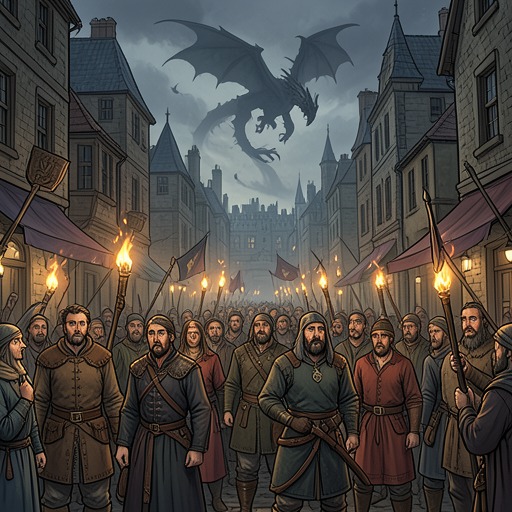
The Watch’s service under Rhaenyra also brought it into open conflict with the Shepherd’s followers. At Cobbler’s Square, five hundred men in black ringmail, steel caps, and long golden cloaks formed behind shields and spears. Largent rode at their head on an armored warhorse with a longsword. His appearance, followed by the Watch’s advance, sent hundreds fleeing through the surrounding wynds, alleys, and side streets.
When the Shepherd was carried away by his followers, Largent ordered his men to seize him and rode after the group. The gold cloaks discarded their spears for swords and cudgels as the confrontation spread. The followers also had weapons, and the clash became a riot and then a slaughter. The Watch, hemmed in by the crowd, could not use its weapons effectively; Largent was pulled from his horse and killed. His death came not in a controlled arrest or formal battle, but in the collapse of the order his force had been sent to impose.
Death and Uncertain Attribution
Largent was later named as the purported killer of Helaena Targaryen, but the account challenges that attribution. It notes that he was eating with three hundred of his gold cloaks at their barracks by the Gate of the Gods when Helaena died. The evidence is offered against the suggestion that Rhaenyra ordered the killing, and it leaves no basis here for assigning responsibility to Largent. His recorded death at Cobbler’s Square is distinct from that disputed accusation.
His final appearance also contrasts with the fearsome reputation established at his appointment. At Cobbler’s Square, Largent commanded a large, armed force and initially helped drive the crowd back; once the crowd surrounded the Watch, however, numbers and confinement undid the advantage of armor, weapons, and his imposing presence. The account’s sequence makes his career a history of command under changing powers, but its ending is defined by the limits of command when the force behind it is overwhelmed.